InboxKit Alternative & Review
InboxKit review with pricing, ratings, pros, cons, features, key drawbacks, and a clear verdict for cold email infrastructure buyers in 2026.
Key Takeaways
- InboxKit plans include a mix of Google Workspace accounts (fully official), Outlook mailboxes, and Azure tenants with an average price per mailbox of ~$3.5.
- Maildoso provides GW accounts and private SMTP mailboxes at a lower price (starting from $0.49).
InboxKit Review
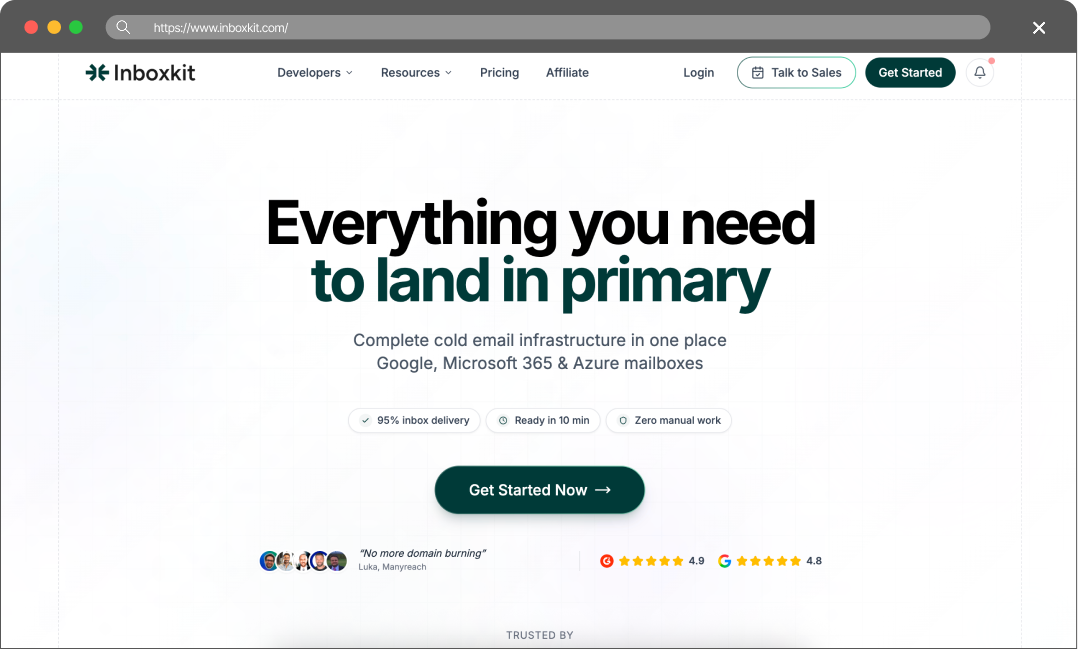
InboxKit review with pricing, ratings, pros, cons, features, key drawbacks, and a clear verdict for cold email infrastructure buyers in 2026.
Rating & Reviews
InboxKit not only offers official google, Outlook and Azure mailboxes at the best price but also offers Infraguard which monitors health of domains and mailboxes proactively and flags issues before it becomes an issue.
— user review
Pros
- Integrated Warmup Tool: InboxKit includes a native warmup feature that helps new accounts gradually build volume within the same dashboard, making it convenient for beginners.
- Clean, Intuitive Dashboard: The UI is very friendly and well-designed, which is great for small business owners who are managing their own outreach.
- Centralized Infrastructure Hub: Manage Google, Microsoft, and SMTP accounts from one unified dashboard.
Cons
- Static IP Infrastructure: Their servers rely on static IP pools. In 2026, this is a major risk; if an IP gets flagged, your entire campaign suffers until you manually rotate or request a new one.
- Surface-Level Deliverability Support: Their support team is great at software questions but often lacks the deep technical forensic knowledge needed to solve complex email deliverability infrastructure drops.
Maildoso Review
Maildoso is an outbound infrastructure provider built around dedicated IPs, white-glove deliverability onboarding, and a flat per-mailbox model with no per-account cap. It is designed for sales and demand-gen teams that need predictable inbox placement at scale without operating their own mail servers.
Maildoso Pros
- Dedicated IPs from day one — no shared-pool contamination from neighbouring senders.
- White-glove onboarding with deliverability engineers; SPF, DKIM, and DMARC configured for you.
- Flat per-mailbox pricing with no monthly send cap and no per-account markup.
- Direct support from a team that operates mail infrastructure, not generic ticket triage.
Maildoso Cons
- Higher entry price than shared-IP services aimed at single-mailbox use.
- Designed for teams sending at scale; overkill for one or two mailboxes.
Detailed Pricing Comparison
| Mailbox type | Price per mailbox | Minimum package |
|---|---|---|
| Maildoso SMTP | $0.49-2.5 | $25 |
| Maildoso GW | $2.7-4 | $40 |
| InboxKit | $3-4 | $39 |
Feature Comparison Table
| Feature | Maildoso | InboxKit |
|---|---|---|
| Mailbox types | SMTP, GW | GW, Outlook, Azure |
| IP type | IP rotation (best for deliverability) | Google / MS 365 IPs |
| API access | Full access | Full access |
| Self-healing mailboxes | ✅ | ❌ |
| Support | Email, Chat, Slack, Tech Audits | Email, Chat |
| Refund policy | 30-day guarantee | No refunds |
| Trials | 300 mailboxes for 30 days | ❌ |
| Final rating | ⭐⭐⭐⭐⭐ | ⭐⭐⭐⭐ |
Cold outreach breaks when infrastructure breaks. A campaign can have strong targeting, clean copy, and good sequencing, but if the mailboxes are weak, the result is still spam placement, account churn, and stalled pipeline. The problem becomes more expensive at scale because every burned mailbox can mean lost warmup time, new DNS work, reconnecting sequencers, and replacing domains.
This comparison looks at InboxKit and Maildoso as infrastructure providers for teams that need outbound-ready mailboxes. The focus is practical: pricing, mailbox types, IP approach, recovery options, support, refund visibility, public reviews, and what each provider is best suited for.
Key Takeaways
InboxKit Review
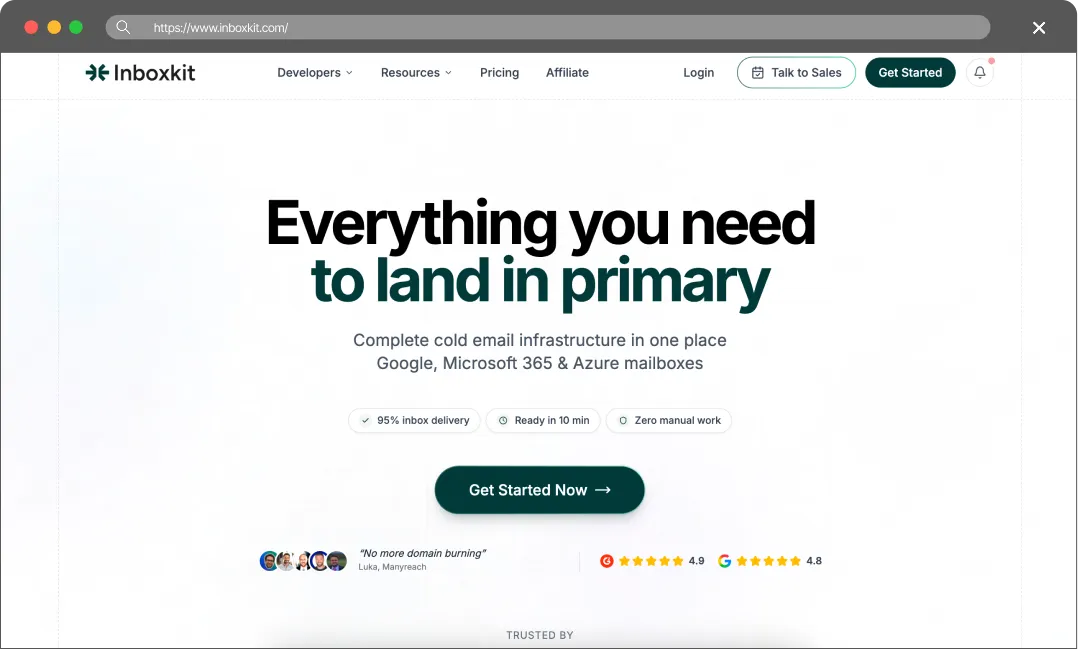
InboxKit is a cold email infrastructure platform that provides official US-IP Google Workspace, Microsoft 365, and Azure mailboxes with automated DNS setup (SPF, DKIM, DMARC), isolated warmup, and 24+ sequencer integrations (Smartlead, Instantly, Lemlist, Apollo, and more).
Launched in the mid-2020s by founder Rahul Lakhaney and operated under Enrich Labs out of Dubai, UAE, it targets agencies and sales teams running outbound campaigns.
What sets it apart: it is the only official Google Cloud partner in this niche, guarantees a 95% inbox placement rate, ships full API access, and bundles InfraGuard – 24/7 blacklist, DNS, and bounce monitoring – with isolated admin panels per domain to prevent cross-contamination.
The True Cost of Bad Deliverability
It’s tempting to choose a provider based solely on the lowest price, but budget infrastructure often leads to hidden costs. When deliverability drops, the consequences usually show up in three areas:
- Burned Leads: High-quality B2B data is expensive. If emails land in spam, those contacts never see the pitch, and the budget spent on data is lost.
- Damaged Domains: Fixing a domain flagged by spam filters can be a massive headache. Often, it’s easier to just buy a new one and start the warm-up process all over again.
- Missed Revenue: Every missed inbox is a missed meeting. In B2B sales, losing even one connection can mean missing out on thousands in closed revenue.
Cold email infrastructure is better viewed as an investment. Maildoso provides the technical tools to protect domain reputation and help keep emails in the primary inbox.
Final Thoughts
To sum up, we can say that InboxKit is a fairly reliable provider and a worthy competitor.
We recommend giving InboxKita try for your campaigns, especially their Google Workspace accounts.
In fact, we were surprised that despite having some market presence, there are almost no mentions of them on Reddit.
The only thing that raises concerns is their Azure tenants. We haven’t heard of any successful use cases for these mailboxes—on the contrary, they seem to burn out extremely fast. Be careful with them.
FAQ
Is InboxKit worth it in 2026?
For teams sending from Google Workspace, InboxKit is a credible choice: it ships official mailboxes, automated DNS setup, a native warmup feature, and a clean UI. The trade-offs are static IP pools and limited deliverability forensics in support. If your campaigns are stable and Google-only, InboxKit covers the basics; if you need IP rotation or hands-on deliverability help, evaluate alternatives side by side before committing.
Does InboxKit offer a free trial or refund?
At the time of writing, InboxKit does not publish a free trial and operates on a no-refund policy once mailboxes are provisioned. Pricing starts around $3–4 per mailbox with a minimum package of $39. Because there is no risk-free way to test the infrastructure, we recommend starting with the smallest available package and validating deliverability on a controlled batch of domains.
InboxKit vs Maildoso — which one fits my outbound stack?
InboxKit focuses on official Google Workspace, Microsoft 365, and Azure mailboxes with static IPs and an integrated warmup. Maildoso focuses on Google Workspace and private SMTP mailboxes with dynamic IP rotation, self-healing mailbox technology, and a 30-day guarantee, but does not currently support Microsoft 365/Azure. If you need Outlook or Azure tenants, choose InboxKit; if you need IP rotation, SMTP at scale, or a refund window, choose Maildoso.
Is InboxKit safe for cold email deliverability?
InboxKit ships properly authenticated mailboxes (SPF, DKIM, DMARC) and bundles InfraGuard for blacklist and DNS monitoring, which mitigates the most common technical risks. The main residual risk is with shared static IP pools: if an IP gets flagged, campaigns relying on that IP can suffer until rotation occurs. Their Azure tenants, in particular, have a reputation for burning out faster than Google Workspace accounts, so handle that mailbox type with extra caution and lower daily limits.