Spintax for Cold Email: How to Use It Right (2026)
Key Takeaways
- Spintax uses
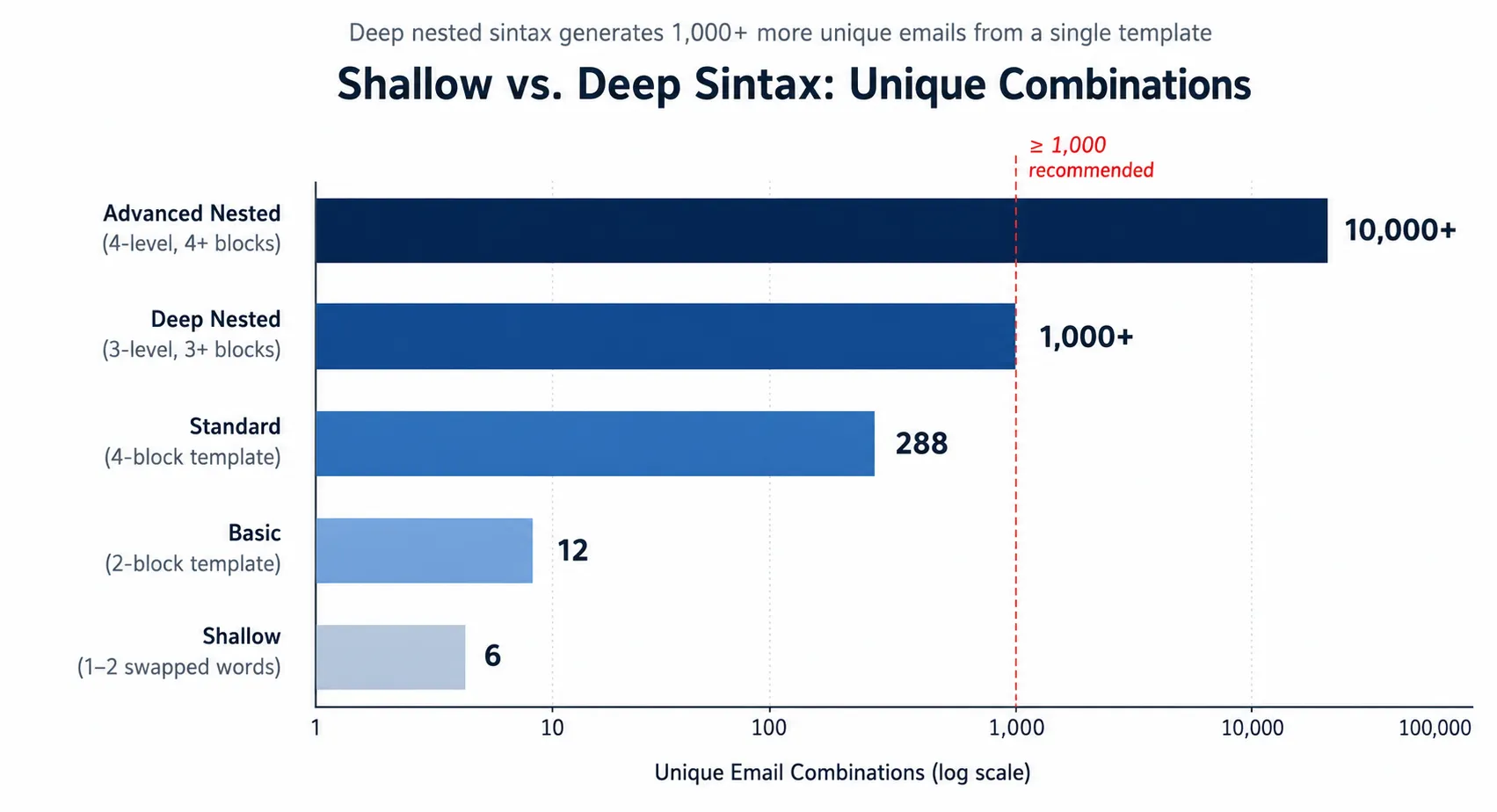
{option A|option B|option C}syntax to generate a unique email for each recipient from a single template. - Shallow spintax (swapping one or two words) provides minimal benefit. We recommend deep, nested spintax with 1,000+ combinations — it’s how you get real variation across a campaign.
- Always proofread your expanded variants before launching — nested combinations can produce grammatically intact but semantically broken sentences.
- Spintax handles content fingerprinting. It does not replace proper domain warmup, authentication, or clean sending infrastructure.
Sending thousands of emails from one template is a deliverability risk. Spam filters learn to recognize repeated patterns: the same subject line, the same opener, the same CTA appearing across hundreds of messages in a short window. The more unique each email looks, the harder it is for filters to batch-classify your campaign. When it comes to spintax in cold email, serious senders use it to build that variation without writing a thousand emails. Here’s how to do it right.
What Is Spintax? (And Why Cold Emailers Use It)
Spintax is a templating syntax that uses curly braces {} and pipe separators | to define multiple alternatives for words, phrases, or sentences. At send time, one option per slot is randomly selected, generating a unique version of the email for each recipient.
Email content fingerprinting is how spam filters clock identical content fast. Same patterns across many messages in a short window? They treat it as bulk. Spintax breaks that pattern by creating content variation at scale: each recipient gets a message that looks distinct to filters, even though it came from the same template.
How Spintax Syntax Works
The core rule: wrap your variants in curly braces, separate them with pipes. One option is chosen per send.
# Word-level
{Hello|Hi|Hey} [first_name],

# Sentence-level
{I came across your profile on LinkedIn.|Your company caught my attention recently.|I stumbled across [company] while researching [industry] leaders.}

# Subject line
{Quick question|One question|A quick one} {about|re:|on} {[company]|your {team|business|approach}}
Notice the empty-variant trick: {Hello|Hi|} — the third slot omits the greeting entirely, adding tonal range without extra words.
All major sequencers — Instantly, Smartlead, Lemlist — parse {A|B|C} syntax natively. No plugins needed.
Shallow vs. Deep Spintax: Why Going Deep Is Worth It
Shallow spintax swaps one or two words per email (“Hi” → “Hello”). The number of unique combinations stays in single digits — minimal uniqueness benefit.
Nested (deep) spintax places {A|B} blocks inside other {A|B} blocks. Each level multiplies the total combinations. This is where the real value is.
Combination math: a simple 4-block template — greeting (3) × opener with nested sub-variants (8) × value prop (4) × CTA (3) — yields 288 unique combinations from a single template. Across subject line + opener + body + CTA, 3–4 nested blocks routinely generate 1,000–10,000+ unique combinations.
What Nested Spintax Looks Like
{Hello|Hi|Hey} {there|[first_name]|},

{I {wanted to|thought I'd|figured I'd} {reach out|connect|drop you a line}|{Quick note|Just a quick message} because {I noticed|I saw|I came across} {your work|what you're building|your profile}}.

{We {help|work with|partner with} {companies like yours|[industry] teams} to {improve|accelerate} {their pipeline|their growth}.|Our {platform|solution} {is built for|specifically helps} {teams like yours|companies in your space}.}
A 3-level nested block with 3 options at each level gives up to 27 combinations from that block alone. Add three of these across a full email and you’re well past 1,000.
The Proofreading Problem — and the Smarter Fix
The power of deep nesting is also its edge case. When three or four levels of variants combine, the results are usually clean — but occasionally produce something like: “I thought I’d connect about your approach to your business.” Grammatically intact. Semantically empty.
Asking someone to manually read 20–30 preview expansions is fine for shallow templates. For a template with 1,000+ combinations, it’s not a realistic workflow — and it still misses most of the edge cases.
There are two better fixes.
Fix 1: Keep every {} block semantically self-contained. Every option inside a block should be interchangeable in meaning, not just in grammar. This is the discipline that prevents broken combos before they happen.
- ✅
"I {wanted to|thought I'd|figured I'd} reach out"— works, because all three phrases convey the same intent. - ❌
"{I noticed your growth|I love your product|Your recent funding}"— does NOT work. You’re mixing a factual observation, a flattery statement, and a news reference in the same slot. The tone shifts wildly depending on which gets picked, and some combinations will read as non-sequiturs.
The rule: if you’d hesitate to use any single option in every email, it doesn’t belong in that block.
Fix 2: Ask your AI tool to audit the template structure, not generate samples. After creating your spintax template with Claude, add one more prompt: “Review this spintax template for structural problems: identify any {} blocks where the options are semantically incompatible, grammatically broken in context, or inconsistent in tone. List specific blocks that need fixing.” This is more reliable than reading random expansions — the AI reviews all blocks at once and flags the ones that will cause problems across thousands of combinations.
In Nikita’s view, this step is non-negotiable: “Once you go three or four levels deep, the template looks clean — until one edge case slips through to a real inbox. Run the audit. It takes 30 seconds.”
How to Generate Spintax: The Practical Approach
Part 1: Built-in AI generators (inside your sequencer)
If you’re already using Instantly, you don’t need a separate tool. Instantly has a built-in AI Spintax Writer that generates {A|B|C} spintax directly inside the campaign editor — no copy-paste, no separate tab. Select your text, click generate, done. It’s the fastest workflow available: you go from plain email to spintax template without leaving the composer. See also: how to use spintax in Instantly .
Smartlead and Woodpecker both support spintax natively — you write or paste {A|B|C} syntax directly into their editors and it parses automatically. Check their docs for any AI generation features: Smartlead spintax guide , Woodpecker spintax guide .
Part 2: Claude (standalone AI — best for depth)
Claude ( claude.ai ) is the strongest option when you need deep nested spintax (3–4 levels) or when you’re not using a sequencer with a built-in generator. It maintains tone consistency across variants, handles complex nesting reliably, and can convert an existing email into spintax without losing its voice. It also works for any sequencer, not just Instantly.
- Pricing: free tier available; Claude Pro at $20/mo (check current pricing at claude.ai)
- Best for: deep nested spintax, tone-consistent variants, converting existing emails to spintax
- Verified live test results are shown in the section below
Prompt to use:
“Rewrite this cold email as a spintax template. Replace key phrases, verbs, and sentences with spintax alternatives (3+ per slot), at least 3 levels deep. Keep tone consistent. Output only the spintax template: [paste email]”
Live Test: What Claude Actually Outputs
We ran the prompt above through Claude to see what it produces on a real cold email. Here’s the actual output, unedited.
Input email:
Hi [first_name], I noticed [company] is scaling its outbound — congrats on the growth. We help teams like yours get better inbox placement without burning through domains. Worth a quick chat to see if it makes sense? Happy to find 15 minutes that work.
Prompt used:
“Generate a cold email body in nested spintax format, 3–4 levels deep, using
{A|B|C}syntax where options can contain{X|Y}sub-variants. Aim for 500+ unique combinations. Output the raw template only.”
Claude output:
{Hi|Hey|Hello} [first_name],

{I {noticed|saw|came across} {[company]'s {recent|latest} {outbound growth|scaling efforts|expansion}|that [company] is {ramping up|scaling|growing} its outbound}|{[company] caught my attention|Your outbound at [company] stood out} — {impressive {trajectory|growth|momentum}|congrats on {scaling|the progress}}}.

{We {help|work with} {outbound-heavy teams like yours|B2B teams scaling outreach} to {get better inbox placement|land more emails in the inbox|improve deliverability} {without {burning through|cycling through|destroying} domains|while keeping {domain health|sending reputation|your domains} intact}|{Better inbox placement|Deliverability at scale} is something we {specialize in|focus on|help teams with} — {no domain burnout|without the domain churn|keeping your infrastructure clean}}.

{{Worth|Would it be worth} a {quick|15-minute|short} {chat|call|conversation} to {see if it makes sense|find out if there's a fit|explore if we can help}?|{Open to|Down for|Up for} a {quick|15-min} {call|chat} {this week|soon}?} {Happy to {work around|find} {your schedule|a time that works}|{I'll|We can} keep it {short|to 15 minutes|focused}}.
Our assessment:
- Nesting depth: 3–4 levels throughout ✅
- Estimated combinations: 600+ ✅
- Semantic coherence: strong — each
{}block is self-contained ✅ - One minor edge case: “Your outbound at [company] stood out — congrats on scaling” reads slightly awkward in some combinations; easy to fix manually
- Overall verdict: production-ready scaffold, would use with minor editing
Boost your outbound with our infrastructure!
Book a 20-minute call with our deliverability team.
Spintax Checklist
Before you launch any campaign using spintax, run through this:
- Write spintax at every level — subject line, opener, body, CTA. Subject line spintax reduces fingerprinting signals — it’s one of the highest-impact places to add variation.
- Keep every
{}block semantically self-contained — every option within a block should be interchangeable in meaning, not just grammar. If any single option would feel wrong in a given email, restructure the block. - Target 1,000+ combinations for campaigns sending 100+ emails per day. Deep nested spintax with 3–4 levels across subject line, opener, body, and CTA reaches this naturally.
- Ask your AI tool to audit the template structure — identify blocks with semantically incompatible or tone-inconsistent options. This is more reliable than reading random expansions and takes 30 seconds.
- Test in your sequencer’s preview — confirm the
{A|B|C}syntax parses correctly in your tool before you send. - Don’t treat spintax as a full deliverability solution — it works alongside warmup, clean domains, and proper SPF/DKIM/DMARC. Not instead of them.
Common Spintax Mistakes
Even experienced senders get these wrong:
1. Letting nesting depth substitute for semantic range. Four nested levels sounds impressive. But if the innermost variants are near-synonyms (“fast” | “quick” | “rapid”), you’re adding structural complexity without meaningful variation. Spam filters don’t just match exact words. According to Laura Atkins of Word to the Wise , a leading email deliverability consultancy: “Spam filters look at message structure and phrase fingerprints. Sending the same message with a few words changed may still trigger spam filters because those filters are looking for structural and phrase-level patterns across millions of messages.” Deep spintax, varying sentence structure and entire phrases rather than just synonyms, is what actually disrupts these patterns.
Further reading: Paul Graham’s A Plan for Spam (2002) established the foundations of content-based spam filtering. Recent research ( VBSF, arXiv:2512.23788, 2025 ) shows modern filters use visual rendering and ML ensembles to detect obfuscation — synonym swaps alone don’t beat them.
2. Reusing the same spintax template across multiple campaigns. A well-built 3,000-combination template feels like infinite variety. But if you run it into the same prospect pool twice, the filter has already seen the pattern. Rotate your base templates, not just the variants inside them.
3. Not accounting for merge field interactions. Spintax blocks that reference merge fields ([first_name], [company]) need extra review. If a randomly selected variant makes the merge field grammatically awkward, “I love what [company] is building at [company]”, you won’t catch it without a preview pass. AI-generated spintax is especially prone to this because it optimizes for plausibility, not for every merge field interaction.
Expert Tips
A few things that separate clean AI-generated spintax from mediocre AI-generated spintax:
- After Claude generates your spintax, ask it one more thing: “Review this template — are there any
{}blocks where the options feel tonally inconsistent or would produce awkward combinations?” This structural review catches problems before they reach inboxes. - Generate subject line spintax in a separate prompt from the body. Subject lines have distinct constraints: character limits, curiosity hooks, no spam-trigger words. Bundling them into a full-email prompt usually produces weaker subject line variants because the AI is optimizing for the whole template. Run a dedicated prompt: “Generate 6 spintax subject line variants for this email — punchy, under 50 characters, no spam words, different structural formats.”
- If the output feels shallow, say so explicitly in the prompt. Single-word swaps are the AI’s path of least resistance. If you get
{great|good|strong}as the only variation in a block, push back: “Make this deeper — replace entire phrases and sentences, not just words. Each{}block should have options that are structurally different, not just synonyms.” One extra instruction usually solves it. - Keep tone consistent within each block. Add this to your prompt: “Keep all options within each
{}block consistent in tone — either all formal or all casual, no mixing.” One sentence in the prompt saves you an entire editing pass.
Spintax Is One Layer — Not the Whole Stack
Spintax does one job: it breaks content fingerprinting. That’s a real problem, and it solves it well.
What the Data Actually Shows
We looked at community-shared campaign data to give you an honest picture — not vendor marketing.
Practitioner-shared A/B tests are the closest thing to real-world evidence here — and they’re worth reading honestly, not as marketing.
Case 1 — A/B test (practitioner account, cold email community, May 2026):
One practitioner running ~500 prospects per arm on Instantly shared this breakdown: B2B SaaS, 3-week run. The spintax arm produced a 41% open rate vs. 38% without spintax — and an 8.4% reply rate vs. 6.1%. Their honest read: “Spintax probably isn’t helping deliverability as much as people say — BUT it’s making the copy feel slightly less robotic, which might explain the higher engagement.” This is a small sample. The direction is encouraging; the magnitude is not a guarantee.
Case 2 — Deliverability recovery (practitioner account, cold email community, May 2026):
Another practitioner shared a more controlled data point: 200 emails/day across 4 domains, 100% identical content — open rates fell from 45% to 18% over 2 weeks. The fix: 3 subject + 4 opener + 3 CTA variations (36 combinations). Open rates recovered to 38% after 1 week, stabilized at 42% after 2 weeks. The variable changed was spintax, and the recovery was clear.
The honest summary: spintax appears to help — both with fingerprinting resistance and, possibly, with making copy feel slightly less templated. But the gains depend heavily on the rest of your stack. If your domains are fresh and your list is clean, you’ll see more lift from spintax. If your reputation is already damaged, spintax won’t fix it.
What spintax doesn’t fix: domain reputation, IP warmup, or broken SPF/DKIM/DMARC. Those are separate layers. If your infrastructure isn’t solid underneath the spintax, you’re still at risk.
If you want to get the infrastructure right — dedicated SMTP mailboxes, IP rotation, and clean sending rails — see maildoso’s plans . For a full walkthrough of the deliverability stack, read our Deliverability Guide .
How We Put This Together
- Direct experience: Nikita Bykadarov’s observations from running maildoso’s infrastructure and working with 6,000+ outbound teams
- Live test: we generated spintax using Claude and documented the full output and assessment in this article
- Community data: two real-world campaign reports from cold email practitioners (cold email communities, May 2026) — original numbers preserved
- Expert source: Laura Atkins, Word to the Wise — one of the most respected email deliverability consultancies
- Technical references: Paul Graham, A Plan for Spam (2002); VBSF research on modern spam detection, arXiv:2512.23788 (2025)
FAQ
FAQ
What does spintax look like?
A basic example: {Hello|Hi|Hey} [first_name], — one option is chosen per send. More complex templates nest variants inside variants: {I {wanted to|thought I'd} reach out|{Quick note|Just a message} about [company]}.
How many combinations do I need for good deliverability?
At maildoso, we recommend targeting 1,000+ combinations for any campaign sending 100+ emails per day. A properly nested 3–4 level template across subject line, opener, body, and CTA easily reaches this from a single template without writing anything from scratch.
Does spintax prevent emails from going to spam?
It reduces content fingerprinting risk — the mechanism is sound, and it’s standard practitioner practice. It does not fix domain reputation, warmup gaps, or broken authentication. Those are separate layers. Our Deliverability Guide covers the full stack.
What’s the difference between shallow and deep spintax?
Shallow spintax swaps one or two words per email — minimal uniqueness, minimal protection. Deep (nested) spintax operates across multiple levels and multiple sections of the email, producing thousands of meaningfully distinct messages from a single template.
Can I use Claude to generate spintax?
Yes — Claude handles nested spintax reliably and works with any sequencer. Prompt it: “Write a cold email opener in spintax format, at least 3 levels deep, using {A|B|C} syntax. Output the raw template only.” If you use Instantly, the built-in AI Spintax Writer is even faster for a first draft — it generates spintax directly inside the campaign editor.
What sequencers support spintax natively?
Instantly, Smartlead, and Lemlist all parse {A|B|C} syntax out of the box — no plugins or workarounds needed. Check your sequencer’s docs to confirm the exact syntax it expects.
What’s the biggest mistake people make with spintax?
Skipping the structural audit. Nested variants can combine into grammatically intact but semantically empty or broken sentences. After generating your template with AI, ask it to audit the spintax structure — flag any blocks with semantically incompatible or tone-inconsistent options. It takes 30 seconds and catches what manual reading misses.
Ready to Send Smarter?
maildoso is rated 4.7/5 on G2 based on 197 reviews — see what customers say .